Sweaters

New Beginnings

One of the highlights of the Knitter’s Review Retreat is New Beginnings, when we each commit to a new project, one that hopefully will be completed in the upcoming year. Clara holds a short but solemn  ceremony of commitment, then we cast on and share our stitches and good wishes with the entire group.
For my New Beginning, I plan to knit Diamond, a very fine jacket in British designer Marion Foale’s book Knitting Collection 1 (distributed by Unicorn Books). I bought the book and the Marion’s own yarn at Tutto, a delightful little yarn shop in historic Santa Fe.

Now, I just might be a little nuts. The gauge on this sweater is 8.5 stitches/inch, which puts it tighter than most of the socks I knit. Given that I plan to add a few inches (two more buttons) to the body length, I figure that this jacket is equivalent to about ten (10) pairs of socks. In order to see some progress, I decided to start with one of the sleeves. The knitting you see above represents about an hour of knitting. At this point, all bets are off on whether I’ll finish in time to wear it to the retreat next year.

New Beginnings Read More »

I Did It

A few days ago, I finished knitting the sweater out of my handspun 3-ply yarn! And I finished it an entire month ahead of my self-imposed deadline of June 1 (I won’t go into what didn’t get accomplished in the last two months).
Even after blocking, the sweater has a wonderful boingy feel that can’t be all attributed to the moss stitch pattern. The yarn really does have more life than a standard commercial merino yarn. But most importantly, this sweater is my color (mud), my size (big and baggy) and my style (plain). Too bad I didn’t plan to have this finished back in January when the temperatures were in the single digits.

With the help of my spinning teacher (Maggie Casey), I learned five ways to make the yarn in a handspun sweater look most even and consistent.
1. Spin about 25% more yarn than you think you’ll need.
2. After spinning, set aside the skeins that look dramatically heavier (or lighter) than the others. Don’t use these skeins.
3. Wind the yarn into many relatively small balls and choose the balls randomly. This helps distribute the slightly thicker and thiner yarns throughout the entire sweater.
4. Use an allover stitch pattern that will also help camouflage differences in yarn thickness.
5. Knit the sweater in the round. This eliminates seams and having to match up pieces that may be slightly different lengths.

I Did It Read More »

Making Progress

I spent most of last week in the mountains with several of my knitting pals. We knitted, watched movies, shopped, and ate very well. I had high hopes of completing my handspun sweater while there, but I still have one sleeve left to knit. In order to spread any yarn variations evenly around the entire sweater, I knitted it from the top down without seams. I picked up stitches for the sleeve around the armhole and worked in rounds to the cuff. I tried a variety of other stitch patterns to set off the lower edge, but they all seemed to distract from the overall look. So, I’ve decided to simply work the non-curling moss stitch to the bind-off edges.

I have 5 balls left, which should be enough to knit the other sleeve and the neckband. So far, I estimate that I’ve spent at least 30 hours already knitting this sweater. I think the spinning and plying took only about 25 hours. I still find it curious that this sweater took less time to spin than to knit. I’m now in the market for fleece to spin for another project. Alpaca might be nice…

Making Progress Read More »

Handspun Heaven

To tell the truth, I’ve been a little nervous about knitting up all that yarn I spun for a sweater. I’m having these existentialistic thoughts about how it’s so full of potential right now and that every choice I make will limit the possibilities. So, instead of staying up all night swatching once I finished fulling the yarn, I set it on my desk and have been simply admiring it ever since.

But my self-imposed deadline of June 1 is creeping up. To prepare for knitting this handspun, I asked my spinning teacher (Maggie Casey!) to give me pointers. We sorted through all the skeins and pulled out the three that appeared heavier than the others. That left me with a total of 33 ounces (936 grams) or 1,626 yards (1,487 meters) of reasonably even yarn. Maggie suggested that I wind the skeins into many small balls so that I’d be sure to mix of the skeins as much as possible. She also suggested knitting it in a texture pattern and at a slightly tight gauge to help mask the thickness variations. I think Maggie is brilliant.

I wound the yarn into 25 small balls, which I put on my desk to admire for several days.

Today, I got out my needles and started swatching. This yarn works up to about 5.5 stitches/inch on size 6 needles. I began with stockinette just to get a feel for the yarn. It was every bit as wonderful as I had hoped: the bounce, the loft, the spring! Following Maggie’s advice, I then tried my favorite of stitch patterns–moss stitch. Yum. (And before you all post comments tell me there’s an error in my pattern, I know.) Now I just have to think about exactly what kind of textured modified-drop shoulder, crewneck pullover this will be. While some doors will close, others will open.


Handspun Heaven Read More »

Sweet Imogene

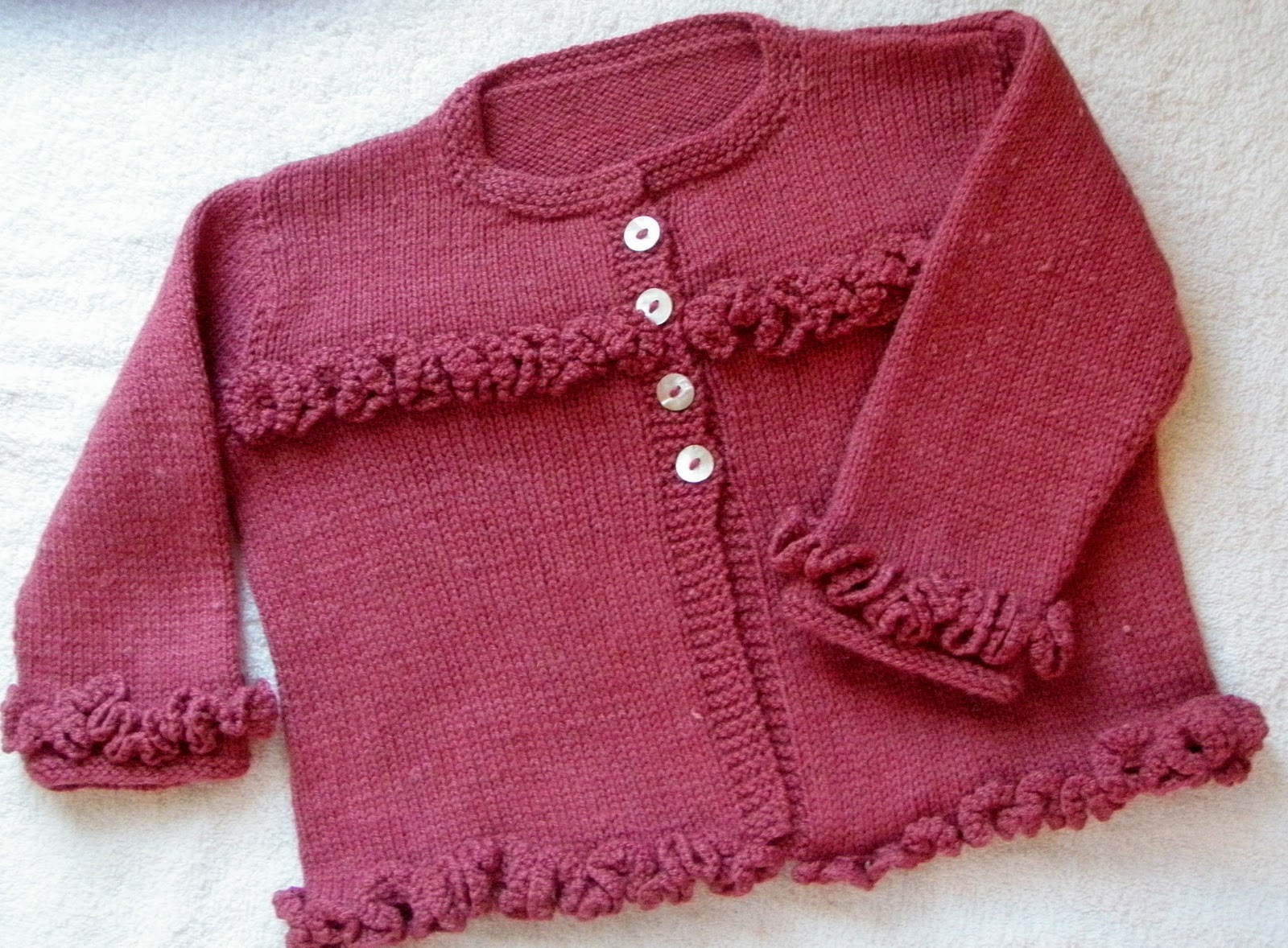
I’m on a roll with projects for Quince & Company. I just finished this baby sweater out of their Tern yarn (75% wool, 25% silk). I made the sweater for little Imogene, born to Quince’s photographer Carry Bostick Hoge earlier this year. I’ve used Tern for several pairs of socks, a scarf, and a shawl, but this is the first time I’ve used it for a sweater. It was such a treat to work with that I plan to use it for a lightweight sweater for myself.

The pattern will get posted on the Quince website after they photograph the sweater and give the instructions a once-over. You can bet that Carrie will take a much, much better photograph that I did here!

Sweet Imogene Read More »

Spinning Progress

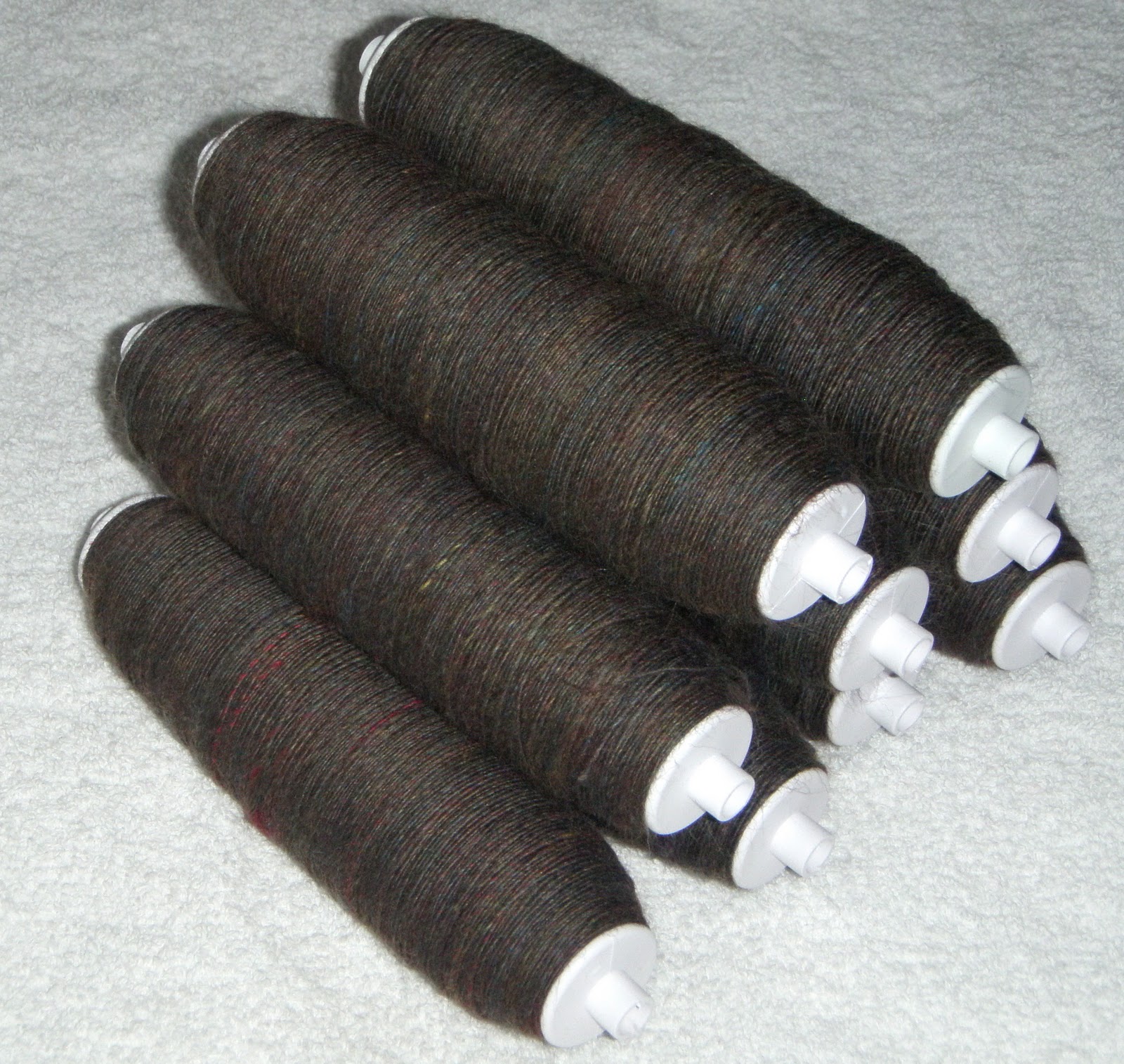
I followed the advice Judith MacKenzie McCuin gives in The Intentional Spinner and have been spinning all the singles I’ll need for my handspun sweater before I start to ply. As of today, I have 9 bobbins, each with about 100 grams of singles. Judith advises pairing the bobbins so that the thin and thick singles will even out overall. Problem is, the thickness ranges within each bobbin. I have no idea which ones might be a little thinner are which might be a little thicker. Therefore, I plan to grab the bobbins randomly when it’s time to spin. At this point, my plan is to make a 3-ply yarn that will be between sport and worsted weight. But who know? It may end up bulky weight even though I tried to spin fine singles.

Spinning Progress Read More »

Spinning Stats

I’ve been keeping track of the time it takes me to spin 100 grams of singles so I can get an idea of just how long it’s going to take me to spin enough yarn for a sweater. It’s not nearly as bad as I expected.
I spin about 32 grams of singles in an hour, or about 100 grams in 3 hours (I weighed the fleece and clocked how long it took me to spin it).

But how many grams do I need for a sweater? According to my very handy The Knitter’s Handy Guide to Yarn Requirements, for a sweater with a 40″ circumference, I’ll need about 2088 yards of sport weight (knitted a 6 sts/inch) or 1475 yards of worsted weight (knitted at 5 sts/inch). Based on the yardage reported on ball bands of wool yarn, sportweight yarn has about 300 yards/100 grams, or 3 yards/gram; worsted weight has about 200 yards/100 grams, or 2 yards/gram. That means that I can divide 2088 by 3 to give me the number of grams of sport weight I’ll need (696 grams) and I can divide 1475 by 2 to give me the number of grams of worsted weight I’ll need (738 grams). Given my spinning rate of 32 grams/hour, that means that it should take about 22 hours to spin enough sportweight or 23 hours to spin enough worsted weight.

Of course, this doesn’t take into account the time it will take to ply the yarn, but that part goes pretty fast. I think it’s fair to estimate that I can produce all of the yarn I need in less than 30 hours. That’s less time than it should take to knit the sweater! Until now, I thought that spinning would take twice as long as knitting (I also foolishly thought that knitting was more enjoyable than spinning). Now my curiosity is sparked–I plan to clock my knitting time, too, so I can compare the two.

In any case, I’m going to get about 30 more hours of pleasure out of this sweater than any I’ve knitted before!

Spinning Stats Read More »

I Must be Nuts

Several months ago I purchased some Ashland Bay 100% merino fleece to spin. I had no idea of how much I’d need for a sweater so I decided to get the entire two-and-a-half-pound ball (better too much than too little). The photo below doesn’t do the colors justice–it’s a luscious blend of olive and brown with highlights of yellow, teal, and magenta.

I haven’t spun since October, so a few days ago I decided to take a break from editing and see if my fingers remembered how. After a half hour so so, I was back into the swing of it and remembered just how much I enjoy spinning. About 5 hours later, I had a full bobbin of reasonably smooth singles.

Now I’m all excited to turn these singles into a 3-ply yarn that I will use to knit a sweater for MYSELF. I figure that if I announce my intentions, I’ll follow through with them. To keep things on track, I’m going to announce a deadline, too.

I hereby commit to spinning enough yarn for a sweater and to knit that sweater by June 1, 2011.

I’ll keep you posted on my progress.

I Must be Nuts Read More »

Happy Ever After

What you’re about to read is a true story, and like a fairy tale, it has a happy ending.

Last September, while on my annual retreat to Taos and Santa Fe with some of my best knitting buddies, I bought some Marianne Isager yarn to make the Sugar jacket from Marianne’s recent book, Classic Knits. In fact, four of us bought the same yarn (but in different colors) to make the same sweater. I bought extra yarn so I could extend the body beyond my thickening mid-section. We called it the Sugar Jacket Challenge. I lovingly placed the yarn in my to-get-to-next basket while I caught up with other work.

As luck would have it, I got busy and still hadn’t started at the end of October. But as in all fairy tales, fate interfered. In November, I attended Clara Parkes’s Knitter’s Review Retreat in western Massachusetts. One of the requirements was that we each bring a new project to start for ourselves on the last day of the retreat. I resisted the urge to take a pair of socks that were under a deadline and instead, I packed the Isager pattern and yarn in my carry-on bag.

Come Sunday morning, Clara gathered us for some concluding words. Because it was Massachusetts—and therefore because she could—Clara surprised us by conducting a group ceremony to join each of us to our new project in blissful matrimony. We repeated words of commitment and vowed to remain true to our projects to their completion, giving them our dutiful attention and forsaking all other projects (within reason) along the way. Then to seal the union, we cast on our stitches and had “witnesses” (read that anyone else in the room) knit a few stitches of recognition and confirmation.

Despite the hilarity of the situation, I found that this gave the Sugar jacket special significance to me. Not only did I buy the yarn with my closest friends, but I started the project in the most wonderful of environments—a weekend retreat with new-found best friends. I can’t remember everyone who knitted a few stitches on the body of my jacket(I wish I had kept notes), but they included Clara herself, Kathryn Alexander, Melanie Falick, and Anne Hanson.

When I returned home, I continued to give the Sugar jacket as much attention as I could. And I finished just in time to wear it while teaching at Midwest Masters in Neenah, Wisconsin in April. Since then, I’ve worn the sweater most every cool day (and there have been a lot of them this spring). I don’t know when I’ve been so pleased with a garment. If fact, I expect we’ll be happy together for a very long time (though now that I see a photo of it on me, I suspect the sweater will start looking for a more flattering partner).

Happy Ever After Read More »